Technology: Online Flow Cytometry
On-Site Identification of Bacteria and Particles in Industrial Processes
The relatively new online flow cytometry enables near real-time monitoring of bacteria and Particles directly in production or bioprocesses.
In order to reliably use the measurement technology established in laboratories in industrial environments, the development of a robust, interference-resistant detection unit was necessary. It must be insensitive to typical process conditions such as dust, vibrations, humidity, temperature fluctuations and air bubbles in the sample. A key challenge lay in the stable, hydrodynamic focusing of particles and bacteria in the measuring cell, enabling continuous, fully automated 24/7 operation under industrial conditions.
If focusing within the measuring cell is omitted, the detection is no longer classical flow cytometric, but purely optical, scattered-light-based particle detection. If the cells are additionally stained, it is also possible, with certain limitations, to detect them via fluorescence measurement channels. Foregoing the focusing process significantly reduces the technical effort and can therefore lead to considerably lower system costs.
Without true flow cytometry (i.e. without clean single-cell focusing), the following effects can typically occur:
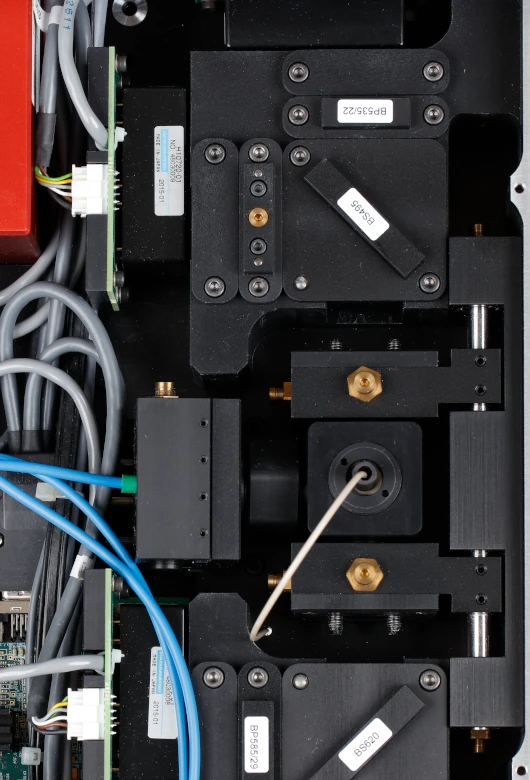
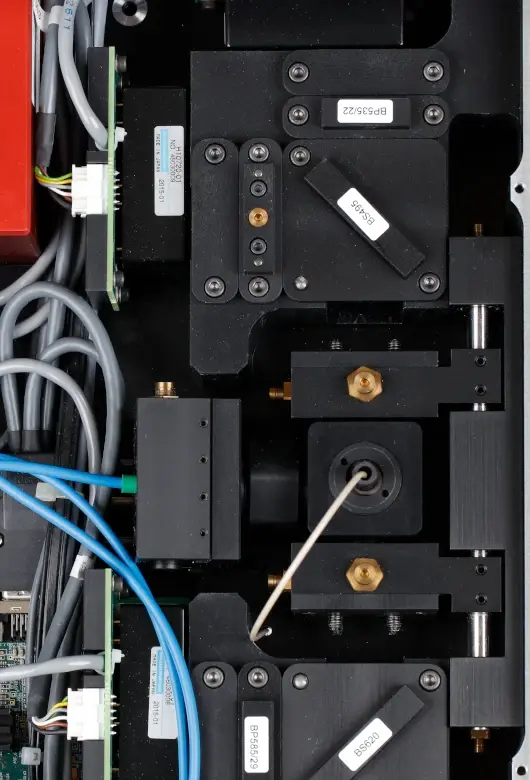
Hydrodynamic Focusing
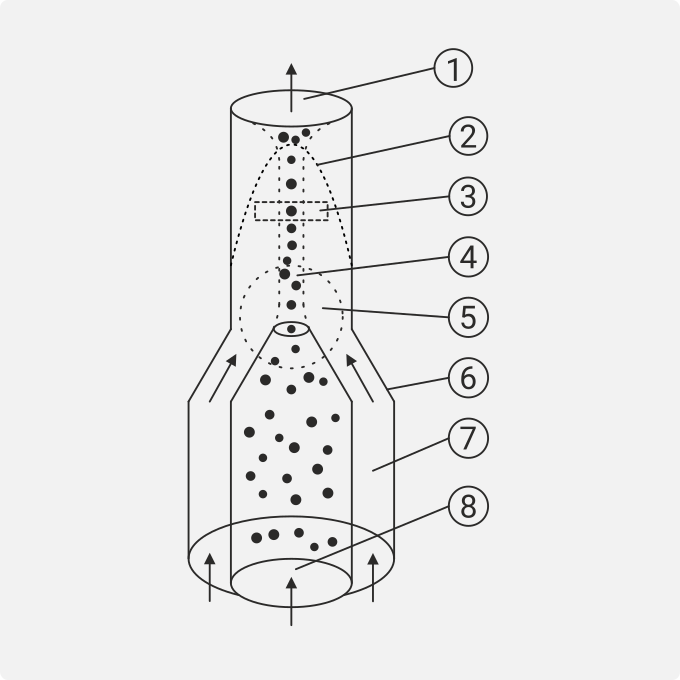
In hydrodynamic focusing, the mantle flow (sheath flow) is used to narrow the sample flow in the measuring cell into a narrow, central fluid thread, so that the cells pass through the laser beam individually and one after the other.
Assignment of hydrodynamic focusing:
Thus the cells are precisely positioned at the laser's focus
Measuring Cell with Hydrodynamic Focusing
Caption
 Outlet:
Mixture of sample and sheath fluid
Outlet:
Mixture of sample and sheath fluid Flow
profile in the measuring cell
Flow
profile in the measuring cell  Measuring
window (interrogation zone)
Measuring
window (interrogation zone) Cells
and particles arranged, surrounded by sheath fluid
Cells
and particles arranged, surrounded by sheath fluid Region
of hydrodynamic focusing
Region
of hydrodynamic focusing Measuring
cell
Measuring
cell Sheath
fluid
Sheath
fluid Sample
feed, capillary
Sample
feed, capillaryAdvantages
 Precise imaging of
cells and particles Very high
reproducibility of measurements High precision due to
stable, laminar flow in the measuring cell Prevents overlapping
(doublets) of multiple cells or particles Very common and
established technology in laboratories Compatible with
conventional laboratory flow cytometers (validation)
Precise imaging of
cells and particles Very high
reproducibility of measurements High precision due to
stable, laminar flow in the measuring cell Prevents overlapping
(doublets) of multiple cells or particles Very common and
established technology in laboratories Compatible with
conventional laboratory flow cytometers (validation)Disadvantages
 Industrial-scale,
true flow cytometry is technically demanding and complex This complexity can
be reflected in the costs Depending on the
measurement interval, the surrounding fluid must be refilled every 4–6 weeks DFZ requires precise
volumetric fluidics
Industrial-scale,
true flow cytometry is technically demanding and complex This complexity can
be reflected in the costs Depending on the
measurement interval, the surrounding fluid must be refilled every 4–6 weeks DFZ requires precise
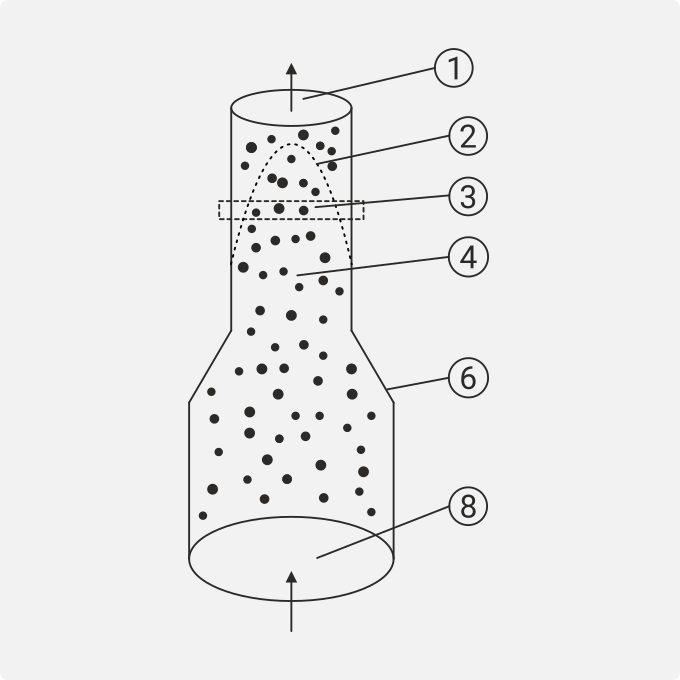
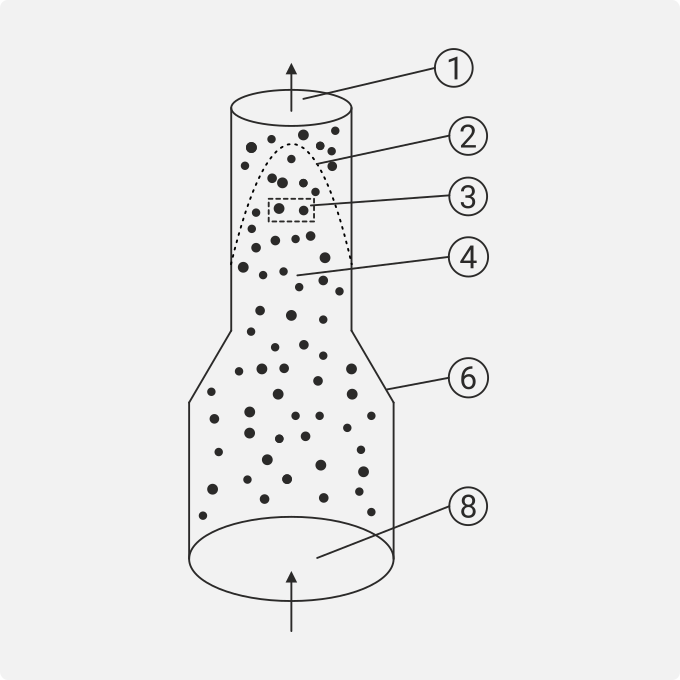
volumetric fluidicsMeasuring Cell without Hydrodynamic Focusing
Caption
Sample
outlet Flow
profile in the measuring cell Measuring
window (interrogation zone) Cells
and particles in disorder Measuring
cell Sample
feedAdvantages
Well suited for
optical particle measurement in scattered and forward scattered light channels Cost-effective
optical arrangement possible Suitable for
measuring particles > 1–2 µmDisadvantages
Does not have
fluorescence measurement channels for detecting labeled cells Lower accuracy, as
multiple particles may be present in the optical measurement range
simultaneously Particles > 1 µm
cannot be detected reliably and consistentlyMeasuring Cell without Hydrodynamic Focusing with reduced Measuring Window
Caption
Sample
outlet Flow
profile in the measuring cell Reduced,
modified measuring window (interrogation zone) Cells
and particles in disorder Measuring
cell Sample
feedAdvantages
 Such a measurement
setup can be implemented more cost-effectively because fewer components are
required No sheath fluid is
needed The fluidic
requirements are significantly lower and can be met with a single pump.
Such a measurement
setup can be implemented more cost-effectively because fewer components are
required No sheath fluid is
needed The fluidic
requirements are significantly lower and can be met with a single pump.Disadvantages
Despite the reduction
of the measurement window (interrogation zone), multiple cells and particles
can still be present simultaneously in the measurement area. Direct comparability
with conventional laboratory flow cytometers is not possible, as this is not a
standardized measurement method. Since less than 50%
of the fluorescently labeled sample is captured, the representativeness of the
measurement is limited and must be mathematically corrected. It cannot be
guaranteed that the cells will pass through the measurement window individually
and sequentially.Conclusion
Flow cytometric detection is generally based on the hydrodynamic or acoustic focusing of the sample stream in the measuring cell, so that cells can be isolated and pass through the laser beam in the center and be optically analyzed. This ensures single-cell analysis in a defined, continuous flow. If cells and particles are not focused within the optical measurement range of the flow cell, and do not pass through the laser beam sequentially and individually, the system does not correspond to classical flow cytometry.
Flow cytometry without focusing is possible in principle, but leads to inaccurate and non-reproducible results because single-cell measurement is not guaranteed. Therefore, focusing methods are an essential component of classical flow cytometry.
The ONTRONIX Online Bacteria Analyzer (OBA) is based exclusively on flow cytometry with hydrodynamic focusing. This generates a continuous sample stream in which cells pass the measurement point individually and can be optically detected.
